What Is Service Design? A Complete Guide
What is service design? See how mapping a bakery order from confirmation to pickup exposes gaps, and which tools help measure a smoother customer journey.


Contents
Service design is the practice of shaping the full experience a customer has with a business, from first contact to follow-up, including visible interactions and the work behind the scenes. It maps connected steps, starts with customer needs, and uses feedback, prototypes, and simple measures to find and fix friction. In practice, it helps services run more smoothly, reduces gaps between handoffs, and makes it easier for customers to return.
Think about the last time a bakery’s online order went wrong. The cake tasted great, but the confirmation email listed the wrong pickup day and nobody could tell you who to call. The product was fine. The experience around it wasn’t.
That gap is what service design closes. It’s the practice of mapping the full journey a customer takes with a business, from first contact to the follow-up, so every touchpoint works together.
This post covers the process, the core tools, how it differs from UX, and how to package it for clients.
Understanding What Service Design Is in Practice
Service design sounds abstract until you see it at work, so here’s how it plays out.
What does design thinking mean in simple terms?
Design thinking is a way of solving problems by starting with the people involved and testing ideas before you commit. It rests on four ideas:
- Multidisciplinary approach. Several perspectives shape the answer.
- Combines design and systems thinking. You shape what you make and how its parts connect.
- User-centered focus. Decisions start with what the person on the other end needs.
- Designing or improving services. The same process works on experiences that unfold over time.
Where products and services start to blur
Products used to be things you bought and kept, and services were things you hired out. That line is blurring. Software as a service (SaaS) is a good example: you pay to use a tool instead of owning a copy. If you want to build one of these yourself, start with how to create digital products.
Streaming, rideshare, and delivery apps follow the same pattern. Even with a ride or a meal, the car or food is physical, but what you’re really buying is the booking, the tracking, and the payment.
The shift is from owning things to accessing them.
How it overlaps with and extends UX
User experience (UX) and service design share a lot of ground. In a rideshare app, the UX work is the screen where you tap to request a ride.
The service side covers everything around that tap: how the wait feels, what happens if a driver cancels, and the receipt afterward.
Experience design is qualitative, built on interviews and observation. Service design extends that thinking across time and channels. Where UX asks how one screen feels, service design asks how the whole journey holds together.
Customer-facing and internal services it covers
A touchpoint is any moment a client meets your work, like the inquiry form or the final delivery. Internal services count too, like human resources (HR) onboarding or the admin behind a studio of one.
A service mixes physical and digital pieces, like a printed welcome card, a shared folder, or an automated reminder. The right mix depends on who the user is.
A client who approves every step needs different guidance than an art director who only wants the files.
Think of a freelance photographer who keeps answering the same three questions about delivery timing. They add a one-page timeline to the booking confirmation, and the repeat questions tend to fade. Small fix, quieter inbox.

How the Process and Parts Come Together
A service is less about one task and more about the chain that links them. Here’s how those pieces connect.
Linked processes that make up a service
Every service is a set of processes and decisions that link together. That process chain needs planning for the people, infrastructure, and materials each step uses.
Done well, that planning improves quality and interaction, and it lets you manage the whole chain, not just one step.
Take a freelance photographer who offers headshot sessions. Booking leads to a questionnaire, then the shoot, selection, retouching, and delivery. Skip the questionnaire and the shoot suffers, because the problem started a step earlier.
Visible front-end work versus hidden backend work
The front-end work is visible: the consult, the shoot, and the proof review. The backend work, like scheduling and invoicing, happens out of sight. The front end is what the client sees; the backend is what they don’t.
A client who arrives with a clear look in mind changes the outcome. Organisations tend to prefer backend work because they can control it. Choosing what is easy to control over what clients want is a habit the marketing concept pushes back on.
The front end happens face-to-face, by phone, or remotely:
- Face-to-face: a studio visit or on-location shoot.
- Phone: a quick check-in that settles questions early.
- Remote: email or video between sessions.
The roles customers play in the experience
Customers play three roles:
- Purchaser: they choose, sign, and pay.
- Co-producer: they supply the brief and feedback, so they help create the result.
- Mindset and mood: a stressed client experiences the same service differently than a relaxed one.
Think of a freelance illustrator whose client sends reference images in the final week, forcing a redraw. One request in the kickoff email would have prevented it. That part matters, so plan for it.
How standardised and custom processes differ
- Standardised: the same steps every time, for consistent output.
- Customised: steps built around one client, which takes more time.
Runners are regulars, repeaters return now and then, and strangers are first-timers.
A volume-variety matrix plots how many clients you serve against how varied their needs are. High volume with little variety points to a standard process; low volume with lots of variety points to a custom one.
Put custom effort where clients notice it, like concept sketches, and standardise the rest. A logo designer whose intake form feeds straight into the concept round gives clients one smooth experience. Clients should never see the seam.
From customer needs to a running service
Five steps take a need to a running service:
- Understand customer needs. Ask what the client is trying to achieve first.
- Define goals and objectives. Agree on targets you both understand.
- Develop service concepts. Sketch two or three ways it could work.
- Prototype and test. Run a small version with one real client.
- Implement and manage. Launch it, then keep watching the chain.
Back to that headshot photographer: testing the questionnaire with one client catches the confusing question early.
Tools and Ways to Measure What Works
Knowing how a service should run is half the job. The other half is seeing how it actually runs.
Mapping and auditing how services run
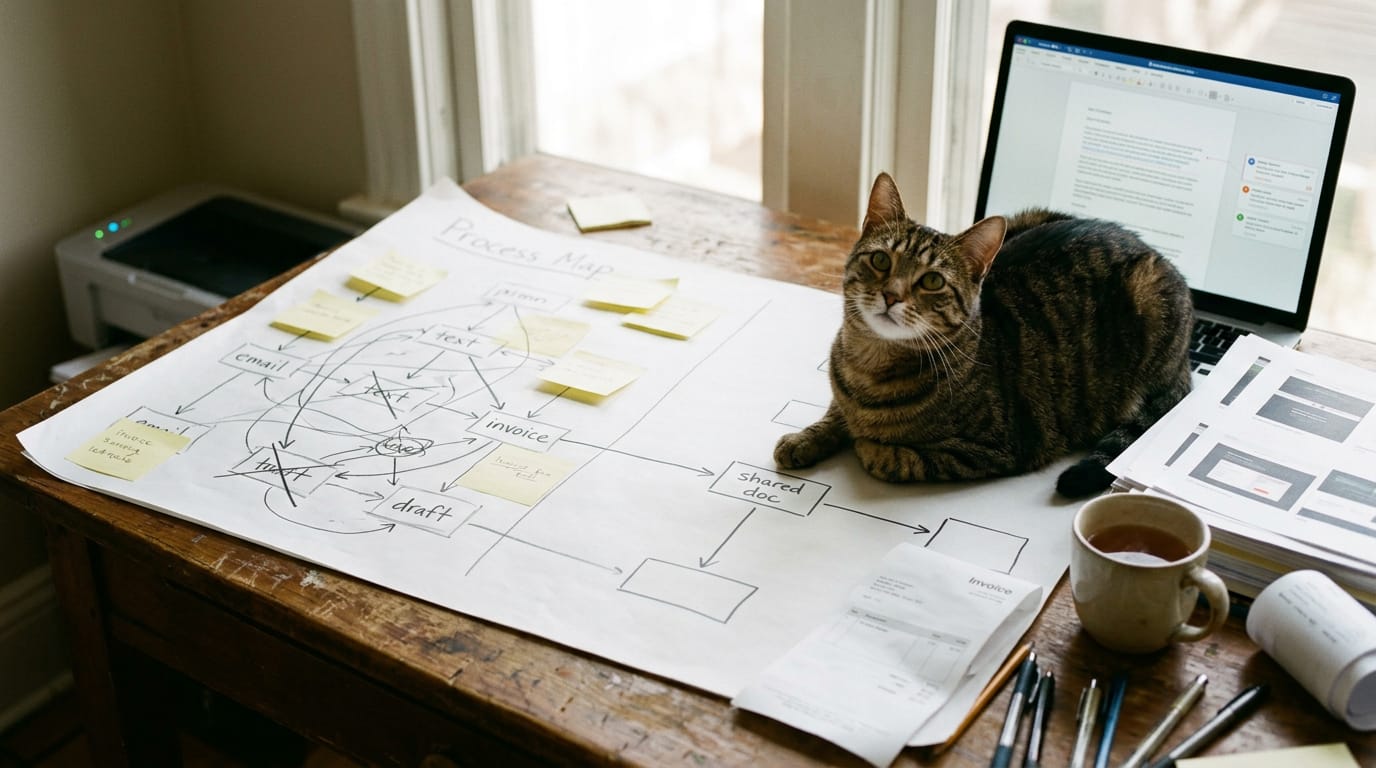
A process map lays out each step of a service in order, revealing slow handoffs and repeated work once it’s on paper. A customer journey map traces the client’s side, while a service blueprint shows what happens behind the scenes.
For example, an illustrator runs a walk-through audit of her onboarding, clicking through each form as a client would. She finds a sketch approval stuck in her inbox for days. One scheduled call fixes it.
A service transaction analysis (STA) rates each exchange between you and the client on a diagram, so weak spots show up as clear scores. A pricing blueprint shows which steps eat the most time, so each one earns its own line on the quote.
Some freelancers sell workshop projects built on the same method.

Ways to gather customer feedback
Feedback comes through:
- interviews
- surveys
- focus groups
Interviews go deepest, while focus groups let several clients react to one idea. Direct customer feedback is simplest: ask one question at the end of a project review.
Then send a short post-service electronic survey once the project closes, while the experience is fresh.
Which measures show a service is working
Three measures are worth tracking:
- Customer relationship length: how long clients stay with you across projects.
- Customer effort: how much work clients must do to get what they need.
- Cost-to-serve: what delivering the service costs you in time and money.
You don’t need all three. Pick the one or two that match your goal and track them, rather than collecting everything. Start small.
Why Service Design Pays Off
Why would a studio of one bother with service design? Its payoff shows up in loyalty, daily operations, new ideas, and suppliers, and we’ll walk through each.
How it keeps customers loyal and competitive
Repeat use builds loyalty when every touchpoint feels easy, from first inquiry to final invoice. Convenience alone won’t hold a client. Smooth beats quick when you want people to stay.
Trends shift, too. An illustrator who learns a client wants input at the sketch stage can build that step in on purpose. Mapping early also lets you shape your offer before competitors do.
Breaking down silos and keeping staff
Service design shows the whole picture, from inquiry to invoice, so the gaps nobody owns become visible.
Silos form when each person guards their own piece, even on a team of two. Silos slow everyone down.
According to a viewpoint in the Journal of Services Marketing, service design can improve organizational culture and employee retention, and its outputs help facilitate organizational change and shape new practices.
The result is a customer-centric business that measures choices against what clients actually experience.
Finding new ideas with less rollout risk
Map current experiences before inventing anything. Research on service innovation and service design notes that studying them can help teams identify issues when developing new services.
Clients can help too. Ask about the friction they’ve hit and what they wish you offered.
Testing early lowers rollout risk. A freelance photographer planning a mini-session package can walk a couple of past clients through booking and delivery first, so confusion shows up on paper.
User experience (UX) research examines how people use a single screen. Service design looks at the whole journey around it. Used together, the two cover both.
Applying it to internal operations and suppliers
The same mapping works internally. Map how you onboard a subcontractor and how you chase invoices, and every visible step becomes one you can streamline.
Employer branding counts for solo studios too, since collaborators’ experience shapes your reputation.
Mapping production shows where time disappears. A writer sending drafts through three channels can move all feedback into one shared document.
Suppliers work the same way. Printers, rental studios, and accountants each serve you, so ask how to make working together easier for both sides.
The Service Designer Role and Career Path
Service designers map the whole customer experience, from first contact to follow-up.
What a service designer brings to teams
A service designer is a creative problem solver who weighs the customer’s view against the business’s. They bring stakeholders, the people with a stake in the outcome, into one room.
They also build prototypes, rough, testable versions of a service, and present them so a team can see how it runs. Common backgrounds include interaction design, human-computer interaction (HCI), and industrial design.
A strong one plans for what a business can deliver, not just what looks good on a slide.
Skills that make a strong service designer
- Communication, verbal and visual. Explaining a plan aloud, then sketching it as a one-page map.
- Research and analysis. Interviewing customers and staff, then sorting what you hear into patterns.
- Creativity and problem-solving. Finding a workable fix when the obvious one is too slow or costly.
- Time management. Juggling interviews, workshops, and deadlines so no stage stalls the rest.
- Interaction design, HCI, and user experience (UX). Knowing how people use screens and physical touchpoints.
Routes in, from degrees to freelance work
There’s no single path in.
- A degree in a related field. Design, interaction, or HCI programs build research habits and a design vocabulary.
- Transitioning from other design. Many designers already talk with clients, map project flows, and walk teams through plans.
- Freelance or contract work. Small projects for local businesses let you learn on paid work and build proof.
- Packaging service design as a freelance offer. Picture a freelance illustrator who designs a bakery’s menus and notices customers getting confused at pickup. She offers a short review (interviews, a one-page map, and a prototype of a clearer pickup flow) as a fixed-fee project. Document it as a case study for your portfolio: the problem, what you found, what you changed, and the outcome, if the client agrees to share it.
Where the job gets hard
- Meeting all customer needs. Different customers want different things, so decide which needs matter most.
- Affordable and scalable services. A pilot built for a few customers may buckle at volume. Design for what the client can actually run.
- Keeping up with trends. Tools shift quickly, so anchor the plan in customer needs first.
- Stakeholder communication. One plan gets read many ways, so keep a single shared map everyone signs off on.
Alignment is often the hardest part.
Service design comes down to one idea: the experience a client has with you matters as much as the work itself. Mapping that journey helps you spot the broken handoffs and missed moments that quietly cost you referrals and repeat work.
Packaged well, that thinking becomes a service you can sell and a portfolio that shows clients you see the whole picture. Start with one client journey and let the results do the selling.
The best client experiences don’t happen by accident. They’re designed.
References
- Viewpoint: advancing service design with practitioners’ insights | Journal of Services Marketing — emerald.com (2025)
- Service innovation and service design — doi.org (2025)
Questions
What is the difference between service design and UX design?
UX design focuses on how a person experiences a particular product or interaction, such as using a screen. Service design looks across the full journey, including the people, processes, and front-end and backend work that connect touchpoints over time.
What is the definition of a service designer?
A service designer is a creative problem solver who maps and improves the full experience customers have with a business. They balance customer needs with what the business can deliver, and often involve stakeholders, research, and prototypes in their work.
What are the 7 elements of design?
The seven commonly named elements of visual design are line, shape, form, space, color, value, and texture. Designers combine them to create and organize visual compositions.
What does design thinking mean in simple terms?
Design thinking is a way to solve problems by starting with people’s needs, exploring possible solutions, and testing ideas before committing to them. It brings together different perspectives and considers how the parts of a solution work as a system.