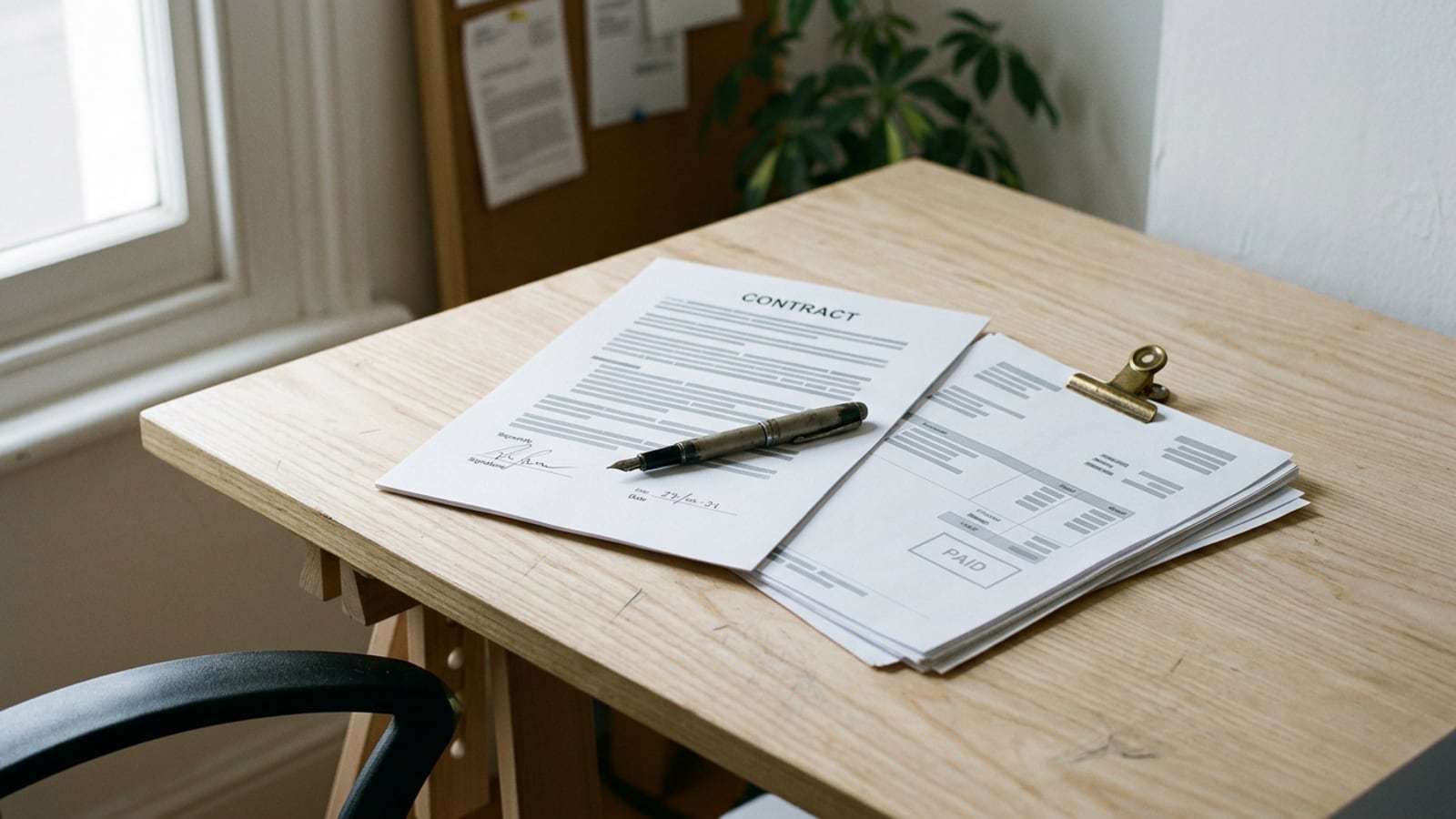
Invoice Meaning in Plain Business Terms
Invoice meaning: see what the document should include, how it differs from bills, receipts, and quotes, and how deposits and payment terms help get paid.


Contents
An invoice is an itemized document a seller sends to a buyer to request payment for goods or services, with the amount owed and when it is due. It records the work, prices, and payment terms, while helping both sides track what is owed; unlike a receipt, it does not prove payment. Clear, timely invoices with specific line items and terms make payment easier to manage and can support deposits or milestone billing.
Picture finishing a logo for a local bakery, sending the final files, and then hearing nothing for six weeks. The work is done, but the money isn’t moving.
An invoice is the document that fixes that: it lists the work you did, what it costs, and when you expect to be paid.
This post covers where the word comes from, what every invoice should contain, and how it differs from bills, receipts, and quotes. Then we’ll show you how to put deposits, milestones, and clear payment terms to work.
Invoice Meaning in Everyday Business Terms
Freelancers send these every week, so it’s worth pinning down what the word means and how it’s used.
What an invoice is at its core
An invoice is an itemized list of goods or services a seller sends to a buyer, asking for payment. Merriam-Webster’s dictionary definition gets at the same idea.
Every invoice does three things:
- It itemizes each good or service with its price.
- It requests payment with a total and a due date.
- It creates an obligation to pay the listed amount.
A logo designer invoices a café for a brand kit, listing each piece with its price. Now the café knows exactly what it’s paying for.
How the word invoice gets used
The word works as a noun and a verb. As a noun, it’s the document: “Did you send the invoice?” As a verb, it means to bill: “We’ll invoice you once the photos are delivered.”
You’ll also hear the idiom “to be invoiced,” as in “You’ll be invoiced for rush fees.”
It traces back to the French envoyer, “to send,” which is a handy reminder: an invoice is something you send.
The word has several senses: a document, an action, and the itemized list that travels with a shipment.
What paying an invoice actually means
Paying an invoice means sending money to settle the amount it lists. The invoice itself is only a request for payment, not proof of payment.
Next, record the payment against it, so your books show what’s still open. The due date sets when money is expected, so an invoice can sit open for weeks. Until it’s paid, it’s a promise, not cash.
Why Invoices Matter for Your Business
An invoice does more than ask for money: it’s also a record and proof of what was agreed.
How invoices help you get paid
A clear invoice speeds payment because everything is in one place:
- Expedite payment. A complete invoice moves through accounts without follow-up questions.
- Track unpaid invoices. Each open one is easy to check against your bank account.
- Predict incoming cash. Open invoices show what’s coming in and roughly when.
- Clear due dates. A printed date turns “soon” into one you both can point to.
Think of a freelance photographer who invoices a catalog client the day the shoot wraps, with the due date printed right on it. When payment runs late, the follow-up is a quick reminder, not a debate.
Invoice financing means borrowing against unpaid invoices, so you get cash before the client pays. You pay for that speed, so weigh the cost first.
Keeping clear records of sales and expenses
Each invoice documents your sales and income. Your client keeps the same paper as a buyer expense record, and together the two copies form a paper trail for both sides.
Invoices also support your accounts receivable, the money clients owe you for finished work. Your invoice date and the date you record income aren’t always the same.
Depending on your books, income may count when you invoice or when you’re paid, so ask your accountant which applies.
Using invoices for taxes and audits
Invoices back up the figures on your tax forms.
The Internal Revenue Service says businesses should keep invoices as records supporting the income, deductions, and credits they report, because they “support the entries in your books and on your tax return.”
Check that guidance for how long to hold onto them. If sales tax applies, show it as its own line so it’s easy to trace. When a question comes up, complete invoices let you answer quickly. Rebuilding from memory is the hard way.
How invoices protect you in disputes
Your invoice is often your first evidence in a payment dispute. Picture an illustrator whose client balks at a third round of revisions. If the invoice lists the agreed revision limit, the conversation is about scope, not guesswork.
Clear invoices help you resolve payment disputes faster, since both sides see the same numbers. A signature can help show both parties agreed, but its legal status depends on your contract and location.
The invoice works best as a record of the agreement, not a replacement for it.
Forecasting demand and building customer trust
Over time, your invoices show how much work is likely and when. For a solo creative, that’s your demand forecast. If you sell prints or merch, they also show how much inventory to keep.
- Customer buying patterns. Track which clients come back and what they buy.
- Professional image and trust. A clean invoice with your name, logo, and clear terms tells clients you run a real business.
Key Parts Every Invoice Should Include
Each part of an invoice answers a question someone will ask before paying. Answer those questions on the page, and you’ll chase fewer payments.
Labels, numbers, and key dates
Start with a clear invoice heading so nobody mistakes it for a quote or receipt. Add a unique invoice number for easy reference. Then list the:
- issue date (when you sent it)
- delivery date (when work finished)
- due date (when you expect payment)
A photographer who delivers a gallery on Friday and invoices that afternoon shows both dates, so the bookkeeper never has to ask when the shoot wrapped.
Listing seller, buyer, and addresses
Put your seller contact details at the top: name or studio name, email, phone, and mailing address. Add the buyer contact details next: the client company, a contact person, and where questions go.
Include your tax ID (tax identification number). Its name and format vary by country.
Finally, separate the billing address from the shipping address. An illustrator who mails signed prints to a gallery branch but bills the head office needs both: where the work goes and who pays for it.
Listing items, quantities, and the total
Give each deliverable its own line with a description that names the work, not the category: ‘Three rounds of logo revisions’ beats ‘Design services.’ Show the quantity and unit price so the math is visible.
- Subtotal: your line items before tax.
- Taxes: any sales or value-added tax your location requires.
- Total due: the amount you expect to receive.
Billable expenses, such as stock licenses or travel, get their own lines. If you bill by the day, show the day rate and days worked. Give revisions their own line too, such as ‘Additional revision round at day rate.’
Vague line items invite arguments. Specific ones get approved.
Telling customers how and when to pay
Spell out your Net 30 terms: the full amount is due 30 days after the issue date. Then cover the rest:
- Accepted payment methods: only the ones you can actually receive, like bank transfer or card.
- Late fees: the charge for paying after the due date, if you use one.
- Early payment discounts: a small reduction for paying early, if you offer one.
- Notes or thank-you: one friendly closing line.
- Contract reference: cite your agreement’s late-fee clause on the invoice so the fee isn’t a surprise.
Put the when on the page as clearly as the how much.
Ways to number each invoice
Pick one system and stick with it:
- Sequential numbering: 1001, 1002, 1003, across every client.
- Date-based numbering: a year and a counter, like 2025-014, so you can date an invoice at a glance.
- Customer or project IDs (identification codes): a client code plus a counter, like BLU-03, so each client’s invoices group together.
Whatever you choose, follow the no duplicates or gaps rule: fix an error with a corrected invoice on the next number, not by reusing the old one. The goal is consistency over cleverness.
Typical layout with a sample invoice
No single standard form exists, but most invoices share three zones:
- Header: branding, the invoice heading, number, and dates.
- Body: buyer details, line items, and totals.
- Footer: payment terms, accepted methods, late-fee reference, and a thank-you.
Here’s a text sample to copy:
- Header: Your Studio Name, Invoice 2025-014, issued [date], due [30 days later].
- Body: Bill to the client’s accounts team. Logo design, quantity 1, unit price [your rate]. Subtotal, tax, total due.
- Footer: Net 30, bank transfer or card accepted, see late-fee clause in our agreement.
Telling Invoices Apart from Similar Documents
Mixing these documents up can leave you chasing money you thought was already coming in.
Why invoices and bills get mixed up
It depends on which side of the deal you’re on. An invoice is the seller’s request for payment, and the same paper arrives as a bill on the buyer’s end.
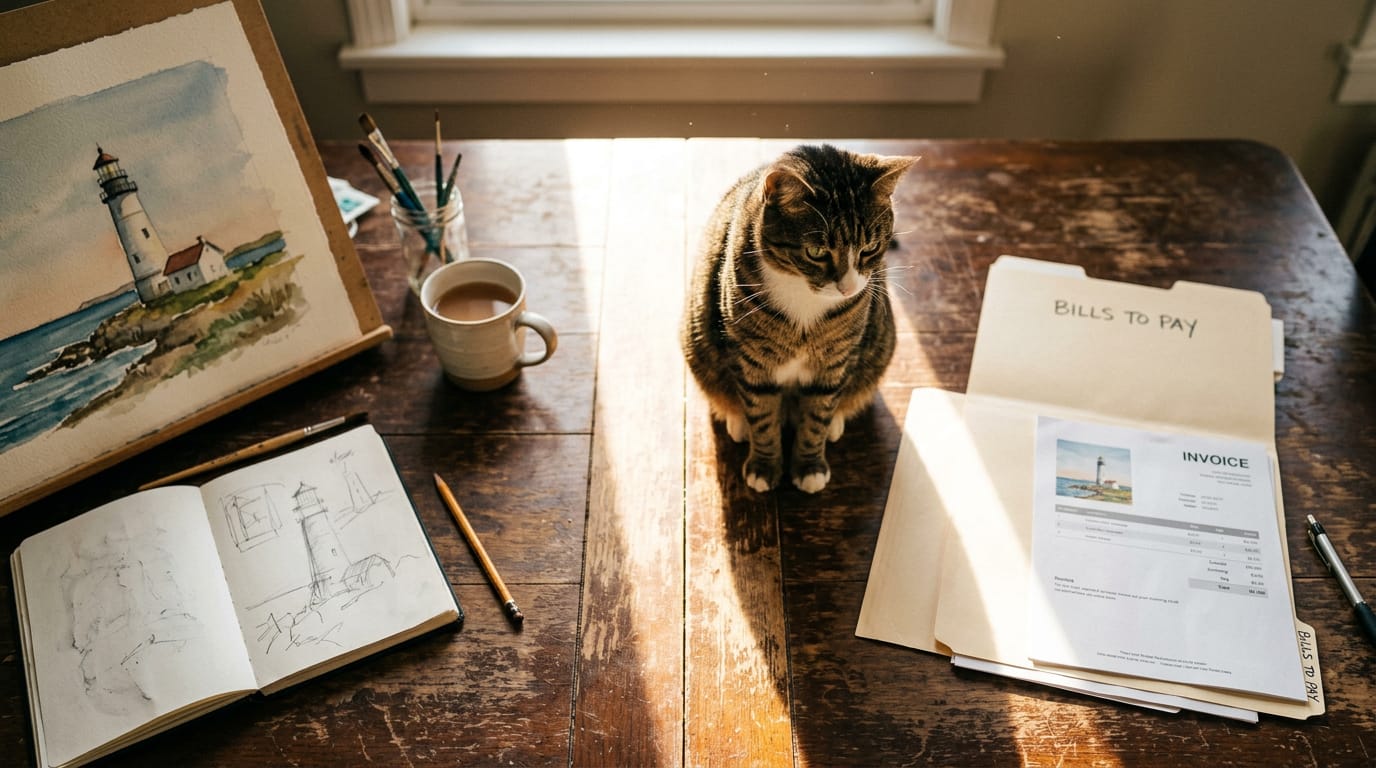
An illustrator’s invoice for a book cover might land in the client’s bills-to-pay folder. Same document, two sides of the table.
From your side, that invoice is an accounts receivable item: money owed to you. From the client’s side, it’s an accounts payable item.
People often treat the two words as interchangeable, and in casual talk that’s fine, but an invoice asks for payment now or by the due date you set.
If a client owes you across several projects, a statement of account summarizes every open invoice and payment in one place.
Receipts prove payment, invoices request it
An invoice requests payment, while a receipt proves it’s already happened. Send the first before the money moves and the second after it lands.
Both count as formal records worth keeping, but they do different jobs.
Quotes and purchase orders come first
A quote is your cost estimate, sent before work starts so the client can say yes, push back, or ask for changes. A purchase order is the buyer’s request for goods.
Picture a writer whose quote lists the scope, fee, and timeline. Once the client says yes, that approved quote anchors everything that follows.
Different Kinds of Invoices You Can Send
Not every invoice does the same job. Some bill finished work, some set up standing payments, and some go out before work starts. Here’s what each one does.
The most common invoice types
- Standard invoice. The everyday bill for completed work, with the amount and due date.
- Recurring invoice. The same bill on a schedule, like a flat monthly fee for ongoing work.
- Pro forma invoice. A preview of what a job will cost, sent before work starts. It’s not a bill to pay yet.
- Past due or reminder invoice. A follow-up on a payment that’s missed its due date.
- Credit and debit invoices (notes). A credit reduces what a client owes, like after a refund. A debit increases it, like when a fee was left off.
- Commercial and timesheet invoices. A commercial invoice itemizes goods shipped across borders. A timesheet invoice bills hourly work from logged hours.
The standard invoice handles most jobs. The rest are tools you reach for when a situation calls for them.
Choosing when to send each invoice
The type matters less than the timing. These five choices decide when the money arrives:
- Advance invoicing. Billing before any work begins, so cash comes in first.
- Milestone invoicing. Billing at agreed project stages, like after sketches are approved.
- Invoicing on delivery. Billing once the finished work is handed over.
- Recurring intervals. How often a recurring invoice goes out: weekly, monthly, or per phase.
- Deposit invoice before starting work. A partial payment that holds your slot.
Think of an illustrator booking a book cover. A deposit holds the slot, a milestone invoice goes out when the sketches are approved, and a final invoice follows delivery.
No single payment has to carry the whole project. Three payments beat one big gamble.
Creating and Sending Your Invoices
Making, sending, and collecting on an invoice comes down to a few practical choices.
Ways to make an invoice
Four common options:
- Spreadsheets and word processors: Free and familiar, but you build every line and total yourself.
- Downloadable templates: A ready-made layout you fill in, so the structure is already right.
- Pre-printed invoice packs: Paper forms you complete by hand, handy if clients still expect paper.
- Accounting software: Creates the invoice and tracks whether it’s been paid.
For example, a photographer can build one template with the deposit line and payment terms already in, then reuse it for every wedding.
Picking invoicing software and online tools
Pick a tool that fits your workload, not the one with the longest feature list.
- Free invoice generators: Web tools that build a basic invoice, often at no cost.
- Built-in payment portals: Let clients pay right from the invoice.
- Recurring billing automation: Sends the same invoice on a schedule, useful for monthly retainers.
- QuickBooks, Xero, FreshBooks: Accounting platforms that combine invoicing with bookkeeping.
- AR automation tools: Software that tracks what clients owe you, known as accounts receivable (AR), and handles follow-ups.
Choosing paper or electronic delivery
Mail vs. email. Mail adds printing, postage, and waiting. Email arrives in seconds.
E-invoices save time. An e-invoice, an invoice created and sent electronically, skips printing and postage.
According to the International Observatory on Electronic Invoicing, moving from paper to PDF (a fixed-layout file) saves over 7% of time per invoice.
A systematic literature review in Digital Government: Research and Practice describes e-invoicing as a significant time saver over manual, physical invoice work.
Paper suits clients who expect it, but it’s the slower route to getting paid. Printing, postage, and mail transit add cost and days, and letters can go missing.

Habits that get invoices paid
- Send promptly. Invoice as soon as the work is delivered, while the job is still fresh.
- Set clear terms. Put the due date, deposit amount, and late-payment policy right on the invoice.
- Polite payment reminders. A short, friendly note a few days before the due date keeps it from slipping.
- Escalation timeline. Decide in advance when reminders firm up, such as a call one week past due.
- Notify customer before invoicing. Give the client a heads-up that an invoice is coming, so it’s never a surprise.
A writer who emails the invoice the day the final draft lands, with the due date printed on it, spends far less time chasing payment. Clarity gets you paid.
What to Do When an Invoice Arrives
When an invoice lands in your inbox, your job is to check it, confirm when it’s due, and fix anything that’s off before it slows your cash flow.
Checking, paying, and fixing invoice errors
Work through these in order:
-
Review for accuracy. Compare every line against your signed quote or proposal, including names, dates, deliverables, and rates. Say a photographer gets an invoice with a rush fee nobody agreed to. A quick check against the proposal takes a few minutes and saves an awkward call later.
-
Check payment terms. Your payment terms are the agreed due date, accepted payment methods, and any deposit already paid. If the invoice doesn’t match them, that’s your first question for the client.
-
Grace periods and late fees. A grace period is extra time after the due date before a penalty applies, and a late fee is the charge for paying after that point. Neither one applies unless your contract says so, so read the wording before you assume either.
-
Payment plans. If a client can’t pay in one go, offer a payment plan: a written schedule with a date and amount for each payment. Have the client confirm it by email so nobody is guessing about what’s owed in month two.
-
Correct billing errors. Reply quickly, name the exact line, and ask for a corrected invoice rather than editing the PDF yourself. Dispute the line, not the whole bill: pay what’s correct on time and keep the conversation on the one item. Speak up early. Silence is what turns a small error into a late payment.
Sending Invoices Across International Borders
A cross-border invoice has two jobs: getting paid the right amount and meeting tax and customs rules on both sides.
Managing currency, exchange rates, and fees
Your bank may add a wire fee (a flat charge for international transfers) and a conversion fee. Ask about both before you quote.
Exchange rate risk is the chance the rate shifts before payment lands. Picture an illustrator in Ohio billing a German publisher in euros, paid weeks later. If the euro weakens in the meantime, you’ll get fewer dollars than planned.
A forward exchange contract (a bank deal that locks in a future rate) takes that guesswork out. A multi-currency account holds several currencies, so euros can stay euros until you convert.
Know what the client sends and what actually lands in your account once those fees have taken their share. Surprises aren’t cheap.
Meeting international rules on taxes and customs
Name the currency on the invoice (euros, Canadian dollars) with the amount, so nobody’s guessing. Show where the work is made (your country of origin) and where the client is (their country of destination), since those often decide which rules apply.
Value-added tax (VAT) is a consumption tax added at each stage of a sale, and duties are fees on goods crossing a border. Whether either applies depends on both countries and what you deliver, so ask an accountant first.
Customs is the government agency that checks goods entering a country, so physical items like printed prints may get reviewed.
Before you send, make sure your invoice includes:
- Your address and the client’s
- A plain description of any physical items
- A line for VAT or duties, if they apply
An invoice is more than a bill with a due date. It’s your record of the work, the price, and the agreed terms, all in one place. Sent clearly, it tells a client what to pay and when, so you can spend more time on the work you’re good at.
Add a deposit, tie payments to milestones, and spell out your terms, and your invoice becomes steady cash flow instead of a hopeful guess. Send it clearly, send it on time, and let the paperwork do the nagging.
References
- eInvoicing will generate €111 billion in VAT revenue and €41 billion in business savings in the EU over ten years — eng.osservatori.net (2025)
- Digital Transformation of Tax Administration and Compliance: A Systematic Literature Review on E-Invoicing and Prefilled Returns — dl.acm.org (2024)
- What kind of records should I keep — irs.gov
Questions
What is invoice financing?
Invoice financing is borrowing against unpaid invoices to get cash before your customers pay. It can improve cash flow, but you pay a fee or other financing costs for access to the money sooner.
What is a pro forma invoice?
A pro forma invoice is a preview of the expected costs for a job, sent before work starts. It is not a bill requesting payment yet.
What is an invoice and its types?
An invoice is an itemized request for payment that lists goods or services, their prices, the total due, and payment timing. Common types include standard, recurring, pro forma, past-due or reminder, credit, debit, commercial, and timesheet invoices.
Where does the word "invoice" come from?
“Invoice” traces back to the French word *envoyer*, meaning “to send.” The origin reflects how an invoice is sent by a seller to a buyer to request payment.
Sources
- What kind of records should I keep | Internal Revenue Service, irs.gov
- eInvoicing will generate €111 billion in VAT revenue and €41 billion in business savings in the EU over ten years, eng.osservatori.net,
- Digital Transformation of Tax Administration and Compliance: A Systematic Literature Review on E-Invoicing and Prefilled Returns | Digital Government: Research, dl.acm.org,