Invoice Number Guide: How to Format and Assign Yours
An invoice number gives each bill a unique ID. Choose a format, fix duplicate numbers, and set up staged invoices for deposits and progress payments.

Contents
An invoice number is a unique code assigned to one bill, helping both seller and client identify the transaction, track its status, and match payments to the right sale. Use a clear, consistent sequence, check for duplicates, and document corrections or cancellations rather than deleting or overwriting issued invoices. A reliable numbering system makes invoices easier to find, reconcile, and retain, while reducing confusion and billing mistakes.
Ever left your coat at a busy restaurant and got back a paper ticket with a number on it? That ticket is how staff find your coat without checking every jacket on the rack.
An invoice number does the same job for your bills: one unique ID that points to exactly one invoice.
In this post, we’ll cover how to format and assign your numbers, fix duplicates, and keep records for years. We’ll also show how they differ from account, bill, and purchase order numbers, with setups for clients who pay in deposits and stages.
What an Invoice Number Actually Is
Your invoice number is the short code on every bill you send. Here’s what it does and where it sits.
What it does for buyer and seller
An invoice number is a unique identifier: each invoice gets one, and no other bill shares it. It’s also a reference code that both sides use to talk about one transaction. Your client’s accounts payable team sees the same code you do.
Think of it as an address label that tells everyone where a payment belongs.
For example, an illustrator billing a publishing house for three cover roughs might send INV-014. Weeks later, when the client’s bookkeeper asks, one code points straight to the right file.
Where it sits and how it looks
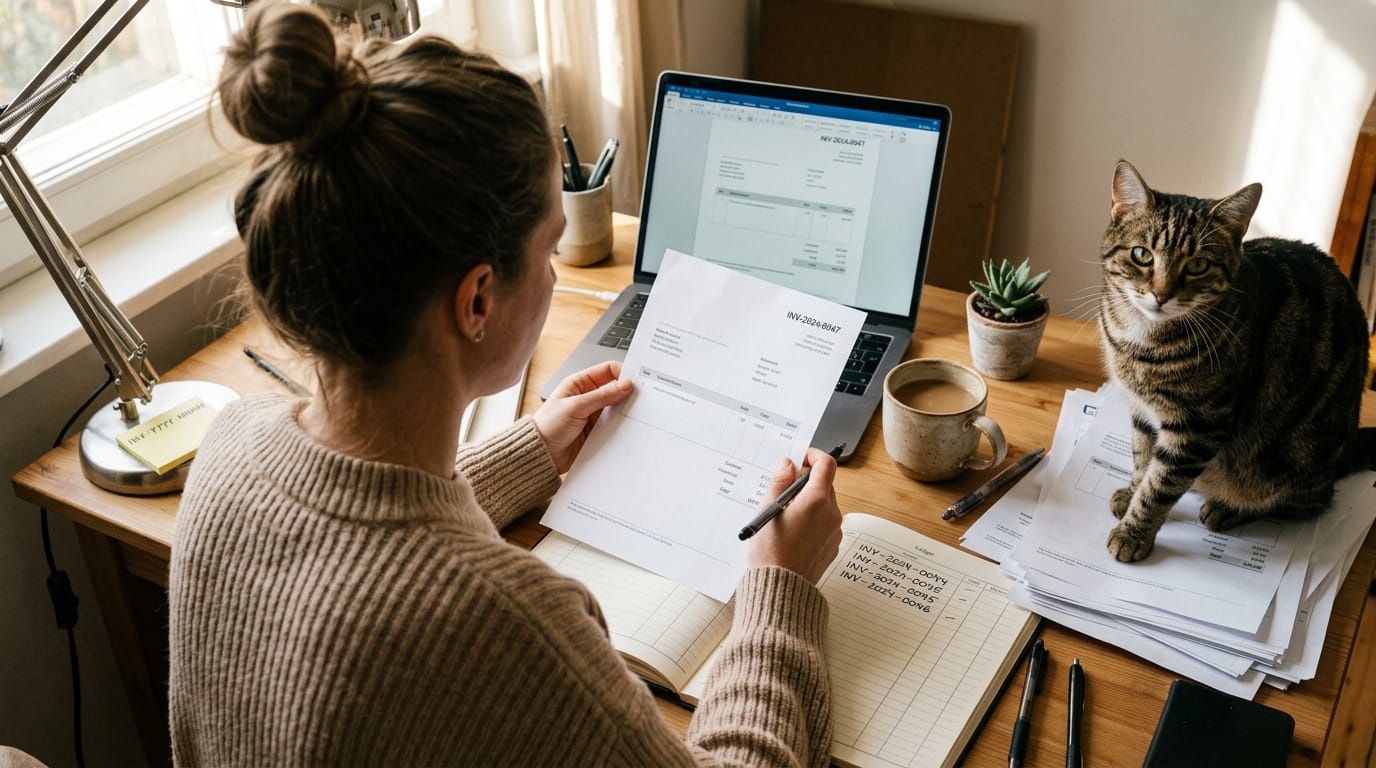
You’ll usually find the number near the top of the page, close to the date and your studio’s name. It can be digits, letters, or both, often with a label like “Invoice No.” or ”#”. A format like INV-001 pairs a short prefix with a running count.
Keep the format consistent across invoices. The pattern matters more than the particular letters you choose.
How sellers use it to check payments
You issue the number yourself, and your client sees it on the bill. When a payment arrives, you use that number to find the sale it covers and confirm whether it’s been paid in full.
Then you reconcile the payment against your accounting records so your books and the bank agree.
Say a photographer receives a payment with only an invoice number attached. That number tells them which job it covers, so they can mark the right one paid and move on.
It’s less about counting the money that arrived and more about matching it to a specific sale. No number, no match.
Why Numbering Your Invoices Matters
Every invoice you send should carry a unique invoice number, a sequence that identifies one bill and only one bill. It takes seconds to add and pays off in ways you won’t notice until you need it.
Finding old invoices fast
When a client asks about “that invoice from the spring,” a number turns a long search into a single lookup. Mark each invoice paid or unpaid as the money lands, and you’ll see at a glance what’s still open.
Searching by number works regardless of client or job cost, so you won’t dig through your inbox by hand.
Keeping customers from being billed twice
We’ve all seen a bill that looks like a repeat. Take an illustrator who bills a publisher in two stages: a deposit, then final art.
If the second request goes out as “Cover art, final” with no number, the bookkeeper may read it as a resend of the deposit and pay twice.
With a number on each bill, the question takes one glance, and you avoid a refund to chase, a confused client, and a dent in trust.
Keeping taxes, books and audits in order
At tax time, numbered invoices give you an income record you can prove, not a pile of PDFs you hope is complete. Match each number against your bank deposits to confirm every payment landed.
The same numbers let you cross-reference sales with expenses like software or stock photo licenses. Counting invoices sent per period is a quick check on your pace.
A clean sequence makes audits and returns easier, since an auditor can see exactly what you billed.
Looking professional in client conversations
Numbered invoices look legitimate and organized, and clients notice. Picture a photographer whose client’s project manager asks about a charge from six weeks ago.
Instead of scrolling through old emails, she replies with the invoice number and usage terms in one message.
Numbers speed up dispute resolution because everyone is looking at the same bill, and citing them in payment reminders keeps cash flow steady. Clarity ends arguments faster.
Common Invoice Number Formats to Choose From
There’s no single correct way to number an invoice, so aim for one you can read at a glance.
Counting up in a simple sequence
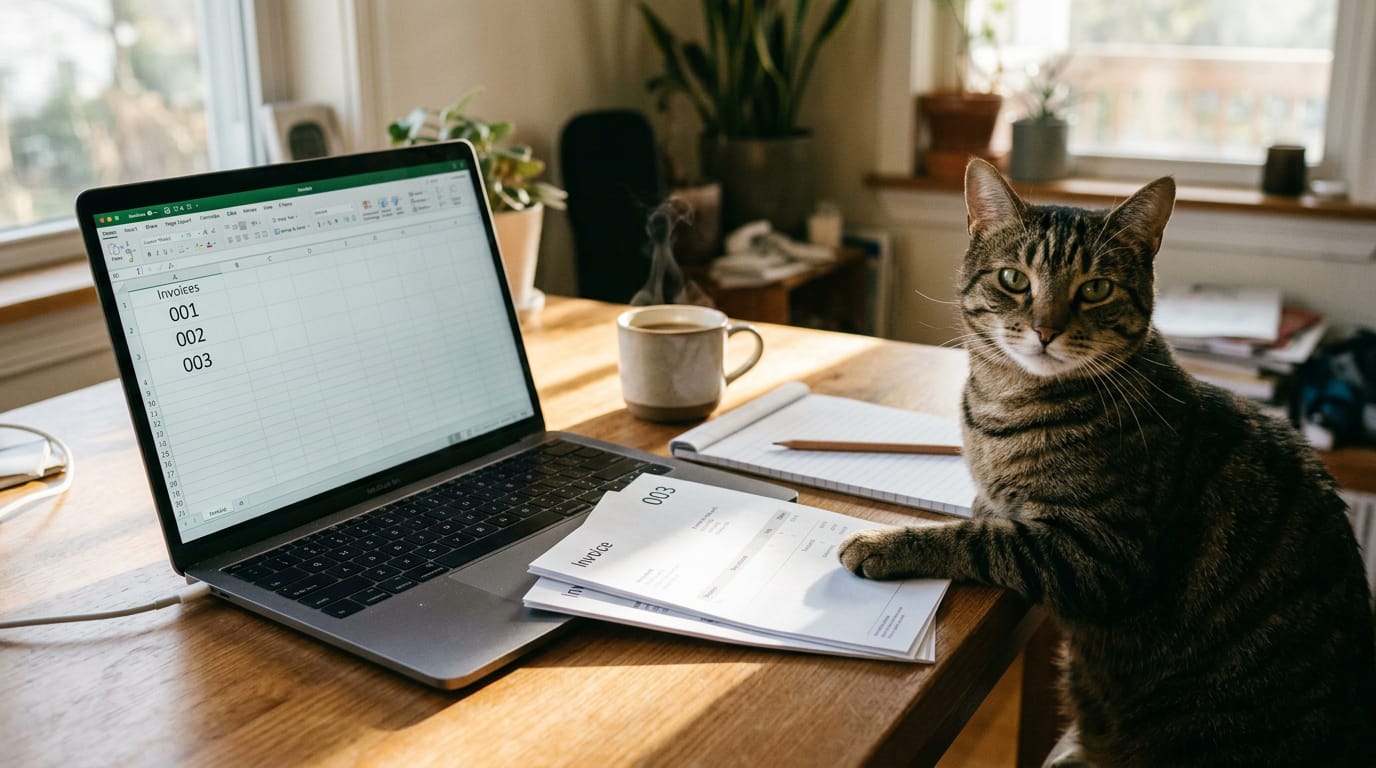
The most basic option is a running count: 001, 002, 003. Each invoice takes the next number, and that’s the whole system. It’s the easiest way to stay organized, and one spreadsheet tab makes accidental reuse rare.
It’s also best for avoiding duplicates and typos. Leading zeros (001 instead of 1) keep numbers the same length and sorting neatly. This format suits startups and solo freelancers who are just getting going.
Simple is boring, and that’s exactly why it holds up.
Building the date into the number
Some freelancers want the date right in the number. A year prefix with a sequence (2025-001, 2025-002) shows when an invoice went out without opening it, while a full date (20250314-001) pins it to one day.
Either way, cross-referencing by date is easy when you need everything sent in March.
A yearly reset keeps numbers short. Starting over at 001 each January means you won’t be handling 0347 after a few busy years. The year tells you when, and the sequence tells you how many.
A wedding photographer can pull up every March invoice in seconds when a couple asks which deposit they’ve paid. The date does the sorting for you.
Using client, project or branch codes
Here the number carries a short code that tells you whose work it is, in one of three common ways:
- Client name or ID, such as ACM-014
- Project code plus sequence, such as BKCV-02-003
- Branch or category prefix for kinds of work, like print or web
This shines with recurring clients. Every invoice shares one code, so the whole relationship sorts into one place.
Deposit and final invoices benefit too. Add a suffix to keep the pair linked: BKCV-02-D for the deposit, BKCV-02-F for the final. Consider an illustrator building a series of book covers for one publisher.
When the final invoice goes out, the client never has to ask which payment it was.
Mixing letters, dashes and custom codes
Letters can carry meaning: INV says invoice, and WEB says web work. Dashes and slashes work as separators, so INV-WEB-2025-014 or INV/WEB/2025/014 is far easier to scan than INVWEB202514.
Build a combined code from date, client, and sequence: a prefix for when, a code for whose, and a count for which one.
A business-name abbreviation works well as the opening letters. A studio called Northwind Type might open every invoice with NWT.
Readable beats clever. A code your bookkeeper can decode in one look is worth more than one only you understand.
Picking the format that fits your business
Your size and billing frequency decide the right format. A solo freelancer sending a few invoices a month can run a plain sequence without trouble.
Someone juggling many projects, with deposits and staged payments, will likely need client codes and suffixes.
Once you’ve chosen, keep it consistent. Switching patterns partway through the year makes searching and matching payments harder.
Avoid generic terms like DESIGN or CLIENT, which could describe anyone and leave two clients sharing a prefix that tells you nothing.
No single format is required, so pick the one you can explain in one sentence. It’s about consistency rather than perfection.
Setting up and Managing Your Numbering System
A numbering system only works when you set it up once and stick with it.
Setting it up step by step
- Select your prefix and format. Pick a short prefix, like INV, and use it on every invoice.
- Decide on including the year. INV-2025 shows at a glance when an invoice was issued.
- Establish your sequence. Each invoice takes the next number.
- Check records before issuing. Look at the last number so you don’t skip or repeat one.
- Link to accounting records. Match each number to its entry in your accounting software.
An illustrator billing a logo in three parts might issue INV-2025-1001 for the deposit, INV-2025-1002 at sketch approval, and INV-2025-1003 on delivery. When the client asks what’s still open, you can answer in seconds.
Where to start and how many digits
Don’t start at 1. A first invoice numbered 1 looks like a placeholder. We’d start at 00001 or 1001 instead. Zero-padded numbers like 00001 stay the same length and sort in order.
Leave room for growth with a few extra digits, so the format never needs changing.
When to reset or change your format
- Wait until a new accounting period. Changing then keeps each period’s invoices in one block.
- Reset at a new financial year. A fresh count can start when the new year begins.
- Restructure your business or change software. Those are good moments to update the format, noting where the old series ends.
- Long sequences prompt a reset. Restarting the count keeps a very long one manageable.
Whatever you change, never skip or repeat a number, since a gap or duplicate invites a bookkeeper’s questions. Simple rule, easy to break.
Keeping numbers consistent and documented
- Pick a method and stick with it. Switching halfway creates a mess, so consistency beats cleverness.
- Keep digital copies, ideally PDF. Save each invoice as a PDF (Portable Document Format) named by its number.
- Document your process across staff. A photographer who hands billing to an assistant can put the prefix and digit count on one page, so the next number is never a guess.
- Make numbers clearly visible. Put the number at the top of each invoice and in the email subject, so the client’s accounts team finds it fast.
Letting Software Handle the Numbering
Hand numbering works until a duplicate reaches a client.
What automatic numbering gets you
Software handles sequential numbering (each invoice picks up after the last) so you never have to track it.
- Avoids duplicates and mistakes. It won’t reuse a number.
- Maintains consistent sequences. Every invoice follows the same pattern.
- Auto-fills the next number. It’s ready the moment you open a new invoice.
- Scales with growth. The sequence holds as your client list grows.
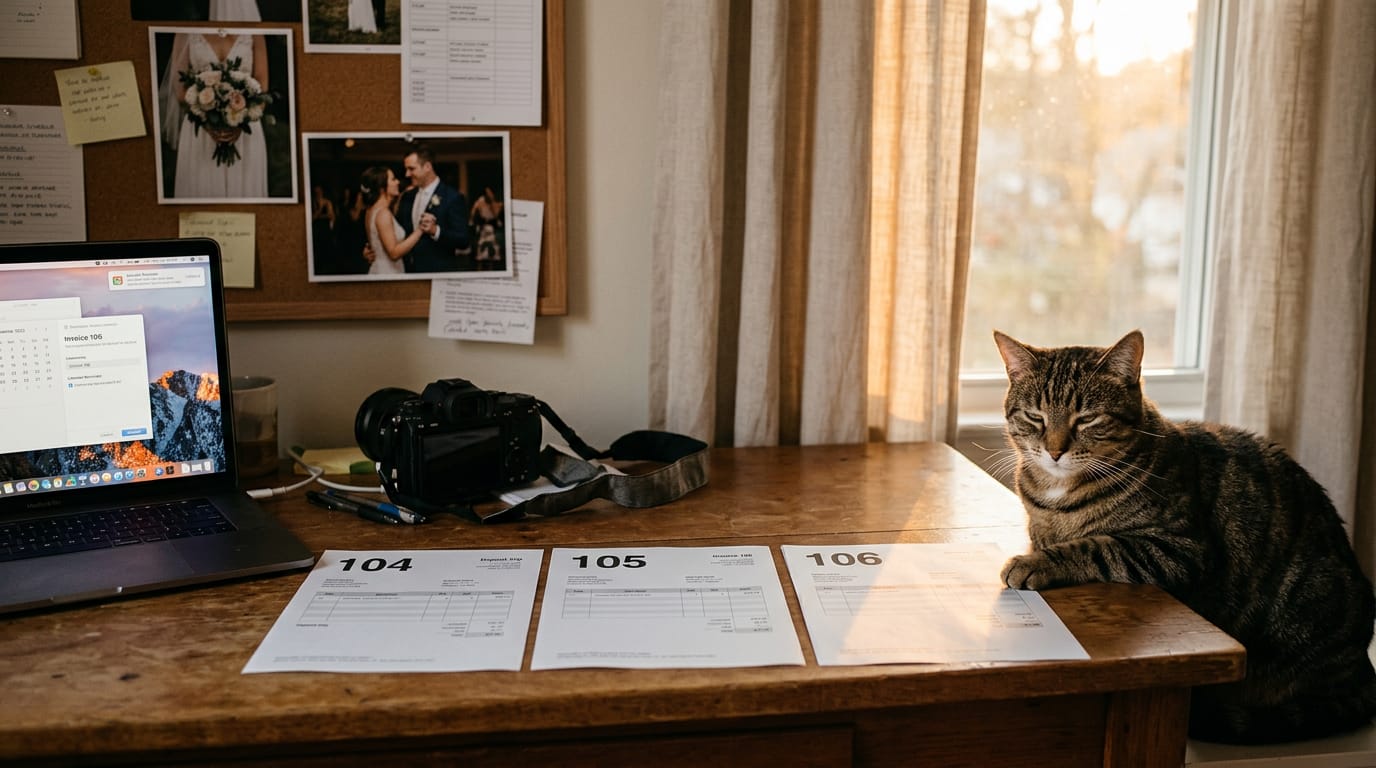
A photographer billing a wedding in three stages (deposit, mid-shoot, final balance) gets each invoice numbered in order. Late on the final balance? The reminder points to the exact invoice.
Other invoicing features that help too
Most tools bundle extras that pay off:
- Payment tracking dashboard. See what’s paid, open, and overdue at a glance.
- Automated payment reminders. The tool follows up so you don’t have to.
- Online payment options. Clients pay straight from the invoice.
- Recurring invoices. Retainer clients get billed on schedule automatically.
- Reporting and compliance. Records stay organized and exportable for tax season.
Good tools don’t add work. They shift it off your plate.
Comparing software with manual methods
Here’s how they compare:
- Excel or templates. Flexible, but every number is on you to track.
- Manual errors increase with growth. What works for a few invoices a month cracks as volume climbs.
- ERP and accounting software. Enterprise resource planning (ERP) suites suit big operations, which is more system than most solo studios need.
- Vendor tools promoted. Before you upgrade for extras, check whether you’ll use them.
- Ready-made invoice template option. A template hands you a finished layout, but the sequence is still yours to track.
Pick the simplest setup that keeps every number straight. Consistency beats cleverness.
Fixing Mistakes, Duplicates and Cancelled Invoices
Duplicates, typos, and cancellations all follow one rule: correct the record through a documented step, never by overwriting it. Here’s how we’d handle each one.
Handling two invoices with the same number
Start with the original records: the file you emailed, the accounting entry, and any payment tied to it. For example, a photographer finds two invoices numbered 2031.
One is an unsent draft, and the other is the paid bill for a finished shoot, so the paid one keeps 2031.
Never reuse an assigned number, even on the unsent draft. Give it a fresh one, then reconcile the affected records so each payment matches exactly one invoice. Fix it while the trail is fresh.
Fixing a number that was entered wrong
A draft is easy to change, but an issued invoice is fixed. If the wrong number hasn’t gone out, correct the draft.
If it has, send a corrected invoice that names the number it replaces, then get the client’s confirmation in writing, even as a short email reply.
Reverse the old one with a credit note, a document that offsets the original amount, or issue a revised invoice instead. Keep the original, the correction, and the confirmation together as your audit trail.
Cancelling an invoice the right way
When a job falls through, the tempting move is to delete the invoice. Resist it: keep the cancelled invoice rather than delete it, because it proves what was billed.
Issue a credit note for the same amount, and don’t skip the number, since a gap invites questions.
Log the date, the reason, and who approved it, even if that’s you. An illustrator whose client pulls a rush job after the first sketches issues a matching credit note and logs the withdrawal. When the accountant asks, one email answers it.
Avoiding the most common numbering mistakes
These four slips cause most of the trouble:
- Undocumented sequence changes. Renumbering a batch breaks the trail, so log every change.
- Manual numbering across systems. Numbering by hand in a spreadsheet and in your invoicing app lets them drift apart. Pick one source of truth.
- Unauthorized changes. Restrict who can edit or delete issued invoices, even if that’s only you and a bookkeeper.
- Regular reviews. Scan your sequence monthly for gaps and duplicates. Ten minutes beats an afternoon hunting for a lost invoice.
Legal Rules and Keeping Records for Years
Some places require invoices to carry a number, and how long you keep them depends on where you bill. Here’s what to check, from India’s Goods and Services Tax (GST) rules to retention periods in three countries.
Why some places require numbered invoices
In some jurisdictions, numbering is required by law. Sequential numbers help authorities verify transactions, so check your local rules before assuming it’s optional.
What India’s GST rules require
According to the Government of India, Rule 46 of the Central Goods and Services Tax (CGST) Rules requires every tax invoice to carry a serial number. Three details matter most:
- Consecutive serial number: the number must run in sequence, and the rule allows one series or several.
- Unique within the financial year: each number can be used only once in a financial year.
- Permitted characters: only letters, numerals, hyphens, and slashes are allowed, in any combination.
A single running sequence that resets each financial year is a simple way to meet both rules.
How e-invoicing generates the IRN
E-invoicing, or electronic invoicing, is a growing area and adds a second number to the picture. The Invoice Reference Number (IRN) is a separate reference, generated through the registration portal, not assigned by you.
Your own invoice number stays, and the IRN sits alongside it.
How long to keep invoices, by country
The retention period is how long records must be kept, and it varies by country:
- United States: The U.S. Internal Revenue Service (IRS) says tax records generally need keeping for 3 to 7 years, depending on your circumstances.
- Canada: The Canada Revenue Agency (CRA) puts the period at six years.
- United Kingdom: His Majesty’s Revenue and Customs (HMRC) generally requires businesses to keep records for six years, and longer for items like equipment expected to last more than six years.
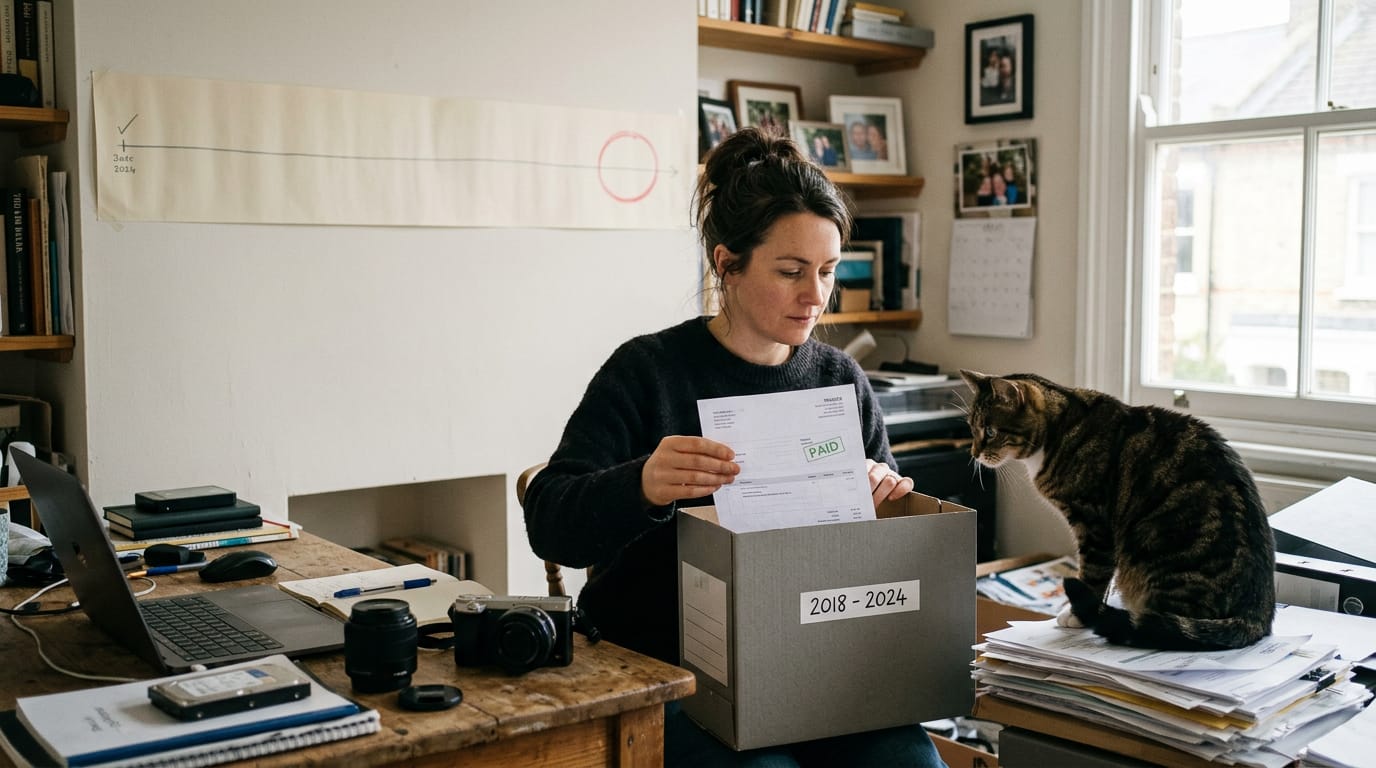
Say you’re a freelance photographer in the UK. When the final payment lands, it’s tempting to archive the folder. Keep that invoice for six years, so a client query two years later finds the paperwork, not a gap.
The clock follows the rules, not the payment. Six years feels like forever.
How Invoice Numbers Differ from Other IDs
Your invoice shares space with several other numbers, and mixing them up causes slow payments. Here’s where the invoice number fits.
Matching invoices to customer orders
The invoice number tells the client which order a bill belongs to. One order can carry multiple invoices, like a deposit and a final balance, so the link runs one order to many invoices.
For example, a book cover illustrator bills a publisher with a deposit invoice and a final invoice. When the art director asks what’s still open, the illustrator quotes the number and matches it to the order in one reply.
Keep each order’s invoice numbers in one place, so matching takes seconds.
Is your invoice number the same as your bill number? That depends on your software, so check the label on the document rather than assuming.
Is my invoice number my account number?
No. The account number is a software record identifier: the ID your system uses to file a client’s record, not the number printed on a bill.
- Not the same as your GSTIN. A GSTIN (Goods and Services Tax Identification Number) is a tax registration number, so it’s neither your invoice number nor your account number.
- Differs from customer ID. A customer ID names the client, while the invoice number names one bill.
Issue date versus proof of payment
The issue date shows when the invoice went out, and the invoice number identifies that document. Neither one tells you whether it was paid.
An invoice requests payment, but the receipt is what proves it. A freelance photographer who files each receipt beside its invoice number can answer a ‘we already paid’ email in a minute. Keep both on file.
What Else Belongs on an Invoice
A number alone won’t get you paid. Here’s what else belongs on the page, so the client can pay without a follow-up email.
The essentials every invoice should show
A complete invoice includes:
- Business and client details: your studio name and contact info, plus the client’s name and billing address.
- Itemized descriptions and prices: “Three logo concepts, two revision rounds” beats “Design services.”
- Due date and payment terms: when payment is expected and how to pay.
- Taxes, totals, and deposits: tax if it applies, the total, any deposit already paid, and the balance due.
- PO number and logo: a purchase order (PO) number if the client issued one, plus your logo.
Take a portrait photographer who collected a deposit at booking. Showing it as paid on the final invoice means the client isn’t billed twice, and the balance is the only number left to chase. Nobody pays a mystery.
Payment terms, late fees and timing
Your terms are less about whether clients pay and more about when, so write them down before the work starts.
Offering a discount for early payment or charging a late fee on overdue bills? Put both on the invoice. A fee nobody agreed to turns into an awkward conversation.
Next, send it promptly after completion. A web designer who wraps up a launch on Friday and sends the invoice that afternoon gets paid sooner than one who waits three weeks. Speed is the easy win.
Clients with several small jobs in one month benefit from a month-end statement, a single page listing every open and paid invoice. An illustrator with a handful of small retail orders each month sends one email to approve everything, not five.
How Common Late Payments Really Are
If you’ve ever chased money for work you’ve already finished, you’re far from alone. Here’s how big the problem of late payment really is, and why the invoice number matters here.
How much money is stuck unpaid
For a studio of one, the real question isn’t whether clients pay late, but how late.
In the UK, the Small Business Commissioner’s research estimates that businesses are owed £26 billion in late payments at any given time, with an average of £17,000 per business affected.
In Australia, a report covered by HuffPost Australia found that small businesses are owed $26 billion by their customers.
According to Small Business Minister Margot James, it’s very hard to believe small businesses are owed so much, and late payments adversely affect their ability to grow. That’s not pocket change.
Here’s where the invoice number earns its keep. It doubles as your payment reference: the note a client types with a bank transfer so you know which bill it settles. Picture an illustrator with three open jobs for the same client.
A transfer lands with no note, and matching it means digging through old emails. If each invoice carries a number and the client quotes it, you can match the money in seconds.
A good invoice number is unique, sequential, and easy to read. It keeps your records clean, makes payments easy to match, and saves you a frantic search when a client asks about a bill from last spring.
Pick a format you can keep up with, build it into your software or template, and stick with it. Once it’s part of your routine, numbering stops being admin you dread.
Clear numbers mean fewer questions, faster payments, and more time for the work you actually love.
References
- How long should I keep records? — irs.gov
- Running a limited company: your responsibilities: Company and accounting records — gov.uk
- Late Payments Research — smallbusinesscommissioner.gov.uk (2025)
- Late payment of invoices: is it an ethical practice — doi.org (2023)
- CBIC, Government of India :: Tax Invoice, Credit and Debit Notes — cbic-gst.gov.in
- Where to keep your records, for how long and how to request the permission to destroy them early — canada.ca
- E-Invoicing Market to Quadruple in Size by 2033, Reaching — globenewswire.com
- Unpaid Invoices Are Suffocating Aussie Small Businesses — huffingtonpost.com.au
Questions
What is the best way to number invoices?
Use a consistent, easy-to-read format and give every invoice a unique number. A simple running sequence, such as INV-001, INV-002, works well; you can also include the year or a client or project code if that helps you organize records.
How do I determine an invoice number?
Choose a prefix and format, then assign each new invoice the next number in your sequence. Check your records before issuing it to avoid gaps or duplicates, and keep the same numbering method consistently.
Is my invoice number my account number?
No. An account number identifies a client’s record in your software, while an invoice number identifies one specific bill. A customer ID and a tax registration number are different identifiers too.
Should invoice numbers be sequential?
Yes, sequential numbering makes invoices easier to track and helps reveal missing or duplicate records. Keep the sequence consistent, and check local requirements because some jurisdictions require consecutive invoice numbers.
Is invoice number is bill number?
Often, an invoice number and a bill number refer to the same document, but the labels can vary by software. Check the document’s label rather than assuming the two numbers are interchangeable.
Sources
- CBIC, Government of India :: Tax Invoice, Credit and Debit Notes, cbic-gst.gov.in
- E-Invoicing Market to Quadruple in Size by 2033, Reaching, globenewswire.com
- How long should I keep records? | Internal Revenue Service, irs.gov
- Where to keep your records, for how long and how to request the permission to destroy them early - Canada.ca, canada.ca
- Running a limited company: your responsibilities: Company and accounting records - GOV.UK, gov.uk
- Unpaid Invoices Are Suffocating Aussie Small Businesses | HuffPost News, huffingtonpost.com.au
- Late Payments Research - Small Business Commissioner, smallbusinesscommissioner.gov.uk,
- Late payment of invoices: is it an ethical practice, doi.org,